

Not All Daily Pay Solutions Work The Same Way
Your EWA Model Determines Control, Risk, and Outcomes
The right model protects paycheck accuracy, keeps direct deposit intact and ensures employees always receive a paycheck on payday. Payactiv is built to deliver all of that: payroll-integrated, employer-controlled, and designed to support employees' growth.
Payroll-Integrated EWA Model
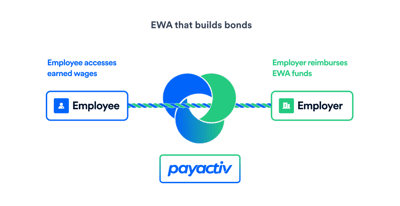
Definition
Provides access to earned wages while keeping payroll unchanged.
Architectural role
Extends payroll functionality while preserving payroll as the system of record.
On payday, payroll runs as usual and the amount already accessed is reconciled through a standard payroll deduction.
Payroll-Intercepted Daily Pay Model
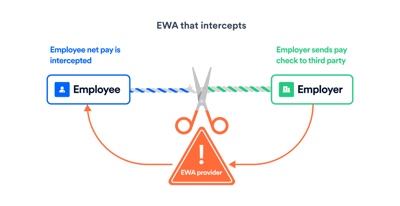
Definition
Provides access to earned wages by routing payday processing through the provider.
Architectural role
Introduces a provider-controlled payment layer between payroll and the employee.
Instead of wages paid via the employer’s payroll, the provider distributes remaining wages after reconciling accessed amounts.
What Payroll-Integrated EWA Solves
Paychecks arrive on time, every time.
No third-party routing means no unexpected delays: employees get paid the way they always have.
Paystubs always match the deposit.
Accessed wages appear as a clean payroll deduction, so employees aren't calling HR wondering where their money went.
Your team stays in control.
Payactiv operates within your payroll system, so your team retains full visibility, reporting access, and the ability to correct errors at any time.
No surprise liability.
Payactiv indemnifies employers for EWA-related claims. No reconciliation gaps, no recovery risk, nothing that lands back on your plate.
What's the Best Fit?
| Payroll-Integrated EWA | Payroll-Intercepted EWA | |
|---|---|---|
| Payroll Integration |
|
|
| Operational Ownership |
Support workflows aligned to payroll operations |
Payroll inherits operational risk without system authority |
| Data Flow |
|
Multi-step provider-controlled flow |
| Access Controls |
|
|
| Reconciliation |
Automatic reconciliation through payroll deduction
|
Reconciliation occurs outside payroll systems
|
Consequences of Choosing the Wrong Model

-
Employees confused by mismatched pay
Paystub net pay does not always match what reaches their bank account, increasing support burden on HR and payroll teams. -
Payroll teams lose control over issue resolution
Employees are redirected to the provider, while payroll lacks the system authority to investigate or fix discrepancies. -
Employers may absorb unexpected financial or operational risk
Including recovery of funds, reconciliation issues, or vendor-driven processes that sit outside payroll systems.
Frequently Asked Questions
How does EWA impact payroll processing?
Payroll-Integrated EWA works within your existing payroll system through automated deductions, requiring no changes to your pay cycles. Payroll-Intercepted EWA reroutes direct deposits through a third-party account, which can create reconciliation complexity and exceptions that payroll teams must resolve manually.
Is there any cost to the employer?
EWA is typically offered at no cost to the employer. The service can be provided as an employee-sponsored benefit with a small transaction fee, or subsidized by the employer as a perk.
How compliant is EWA?
Compliance depends on architecture. Payroll-Integrated EWA maintains wage assignment controls and clear audit trails through your payroll system. Intercepted models that redirect wages through third-party accounts may face wage assignment, escheatment, and banking compliance questions depending on your jurisdiction.
Can EWA cause overdraft fees for employees?
When properly integrated with payroll, EWA deductions happen before net pay distribution, preventing overdrafts. In intercepted models where the provider controls the final distribution, timing mismatches or calculation errors can result in insufficient funds reaching employees' accounts.
How long does implementation of Payroll-Integrated EWA take?
Payroll-Integrated EWA typically takes 4-8 weeks depending on your payroll system and integration requirements. The provider works directly with your HRIS and payroll teams to ensure seamless data flow and automated reconciliation from day one.